
JPMorgan Chase: Enterprise Enablement Platform & Internal Consultancy Model
A Fortune 100's 2-phase enterprise transformation integrating UX, governance, and AI-enabled content systems

Overview
This enterprise transformation began with the Agile Center of Excellence (ACE), consolidating fragmented internal communications into a governed enablement ecosystem. Building on those outcomes, the organization re-engaged the same end-to-end architect to evolve ACE into Operating Model Enablement (OME) — a scalable, pull-based internal consultancy model supported by UX-driven design, intake systems, and playbook-as-a-platform governance.
The result is a modern enablement platform that translates operating-model complexity into clear, usable experiences, aligning strategy, execution, and sustainability across product, agility, and engineering communities.
“The best consultant experience I have ever had — by far.”
— JPMorgan Chase Managing Director, Operating Model Enablement (OME)
The Challenge
Enterprise transformation teams often face the same structural barriers:
- Fragmented content spread across disconnected tools and touchpoints
- Role confusion around “what support exists” and “where to start”
- Difficulty scaling expertise without creating new operational overhead
- Governance treated as documentation rather than embedded design
- High demand for advisory support without a clear intake or engagement model
ACE was created to address these needs — but its success also revealed the limits of a top-down Center of Excellence approach.
OME emerged as the next evolution: a pull-based consulting model designed for clarity, access, and sustained adoption.
The Approach
This engagement was executed as two sequential, connected transformations:
Phase 1: ACE Foundation
Establish a centralized enablement platform with structured communications, toolkits, and governance.
Phase 2: OME Evolution
Redesign the model into a customer-driven internal consultancy with a unified intake experience and operating-model-first UX.
Across both phases, the work treated content and UX not as support functions, but as operational infrastructure.
Phase 1: Agile Center of Excellence (ACE)
ACE established the foundational ecosystem:
- Designed and implemented the core communications and knowledge architecture
- Created initial playbooks, toolkits, and persona-aligned journeys
- Introduced governance standards and editorial workflows for consistency
- Unified a fragmented enablement landscape into a coherent operating platform
Outcome: A scalable foundation for enterprise agility communications, serving as the baseline for future evolution.
Phase 2: Operating Model Enablement (OME) — Re-engaged Post-ACE
OME was designed as the next-generation model: a pull-based internal consultancy built on ACE outcomes and lessons learned.
Key components included:
- Operating Model Definition Made Usable
Created enterprise-ready explanations and visual frameworks answering: What is an operating model, and why does it matter here?
- Single Front-Door Intake Experience
Designed a unified entry point allowing customers to describe needs intuitively, while enabling structured backend triage across practice areas.
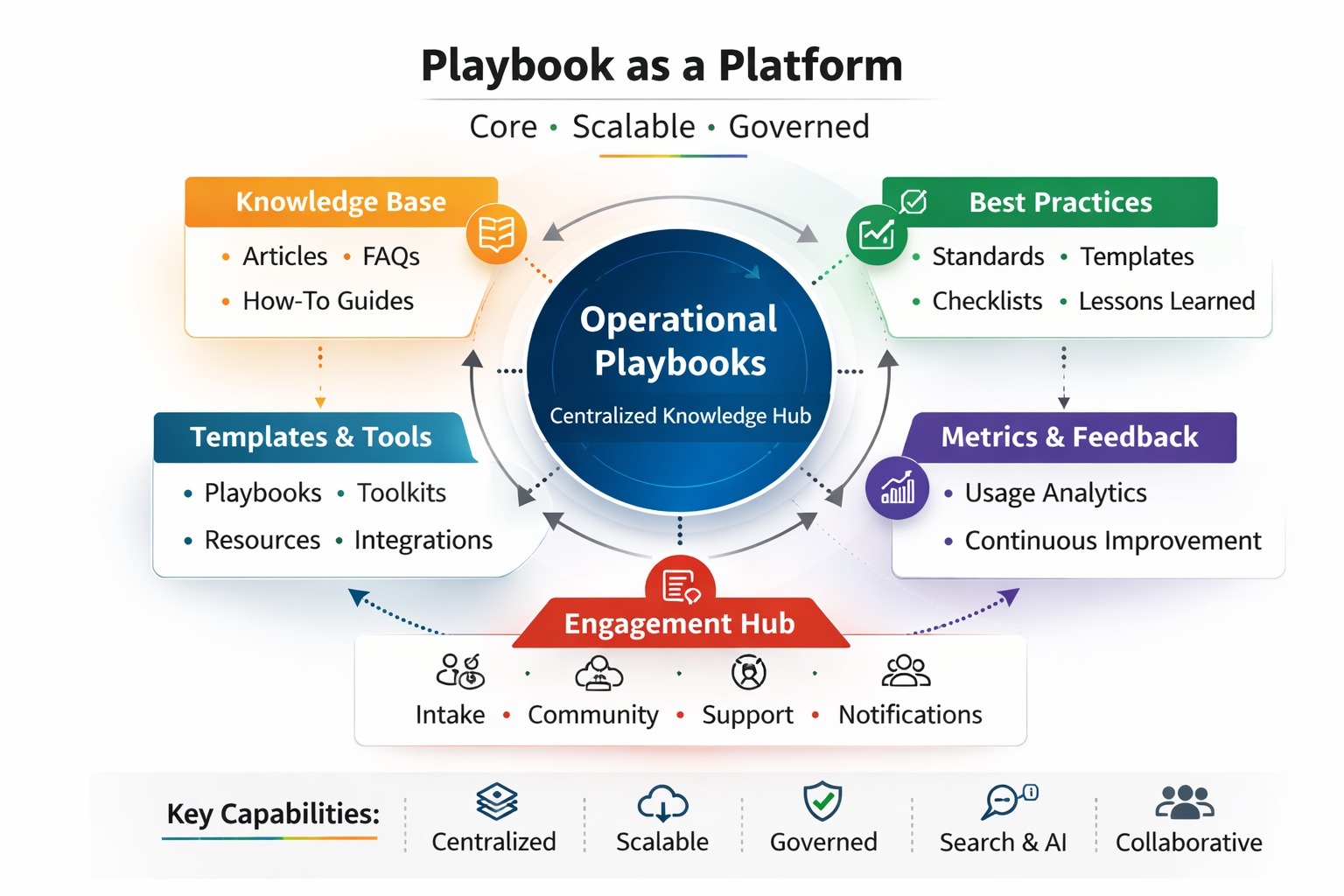
- Playbook-as-a-Platform Model
Transformed static documentation into a living system supporting:
- Engagement delivery
- Governance and standards
- Toolkits and reuse
- Continuous improvement and learning
UX-Driven Information Architecture & Content Design
Modernized site structure and navigation to reduce cognitive load and clarify pathways for product, agility, and engineering audiences.
Governance Embedded into Execution
Established repeatable editorial and operational systems, including:
- Lifecycle management
- Success story capture
- Newsletter integration
- Content performance governance
Rather than separate governance documentation, sustainability was designed directly into the user experience.
What Made This Transformation Different
Unlike traditional communications engagements, this work operated at the level of enterprise enablement infrastructure, integrating:
- Operating model clarity
- UX and service design
- Governance and content operations
- AI-enabled workflow potential
- Execution-ready artifacts and delivery systems
The result was not a content refresh — it was an operating platform for internal consulting and transformation support.
Impact
- Enabled a scalable internal consultancy model spanning multiple practice areas
- Reduced friction for customers through a single intake and triage experience
- Improved clarity and adoption through UX-centered design and messaging
- Embedded sustainability through governance, lifecycle, and operational workflows
- Created a reusable blueprint for enterprise transformation enablement
Related Work
- Enterprise Cybersecurity & AI Enablement at Scale (Verizon)
- Global Cloud Transformation Communications (Pfizer)
Interested in how UX, governance, and content systems can optimize operations and scale transformation?
Post a comment